
The property market in the United Kingdom is one of the most complex and regulated environments in the world. When purchasing a home or managing a commercial asset, the choice of surveyor is not merely a matter of convenience but a critical risk management decision. According to recent industry data, over 40% of first-time buyers encounter unexpected structural issues after purchase, highlighting the vital importance of professional oversight. This article compares the two primary tiers of surveying services: those regulated by the Royal Institution of Chartered Surveyors (RICS) and those operating outside this framework. Understanding the differences is essential for protecting your investment and ensuring legal compliance. (Contact Us)
Why RICS Regulation Matters
The Royal Institution of Chartered Surveyors (RICS) is the world's leading professional body for land, property, construction, and infrastructure. Being RICS-regulated means the surveyor adheres to strict ethical standards, professional competence requirements, and client care protocols. This regulation provides a layer of consumer protection that non-regulated surveyors cannot offer.
RICS members are bound by the RICS Rules of Conduct, which mandate transparency and accountability. If a dispute arises, clients have access to a formal complaints procedure and potential redress through the institution. This is particularly crucial in high-value transactions where errors can cost hundreds of thousands of pounds. Non-regulated surveyors operate without this safety net, leaving clients vulnerable to negligence with limited recourse.
Furthermore, mortgage lenders often require RICS-regulated surveys for loan approval. Banks rely on the standardized reporting formats provided by RICS to assess the collateral value of a property. Without this certification, securing financing can become significantly more difficult or impossible for certain property types.
Understanding Service Tiers
Comparing surveying services requires a clear understanding of the specific reports available within the RICS framework. The institution has standardized three main levels of survey, each designed for different property conditions and ages.
RICS HomeBuyer Report (Level 2)
This is the most common choice for standard properties built with conventional materials. It provides a visual inspection of the property's condition, highlighting obvious defects. It is suitable for flats, maisonettes, and houses that appear to be in reasonable condition. The report includes a traffic light system for condition ratings, making it easy for laypeople to understand.
RICS Building Survey (Level 3)
Formerly known as a Structural Survey, this is the most comprehensive option. It is designed for larger, older, or non-standard properties. The surveyor will inspect accessible parts of the building, including roofs, walls, and floors, to identify structural issues. This service is essential for properties that have been significantly altered or are in a state of disrepair.
Non-RICS Comparative Surveys
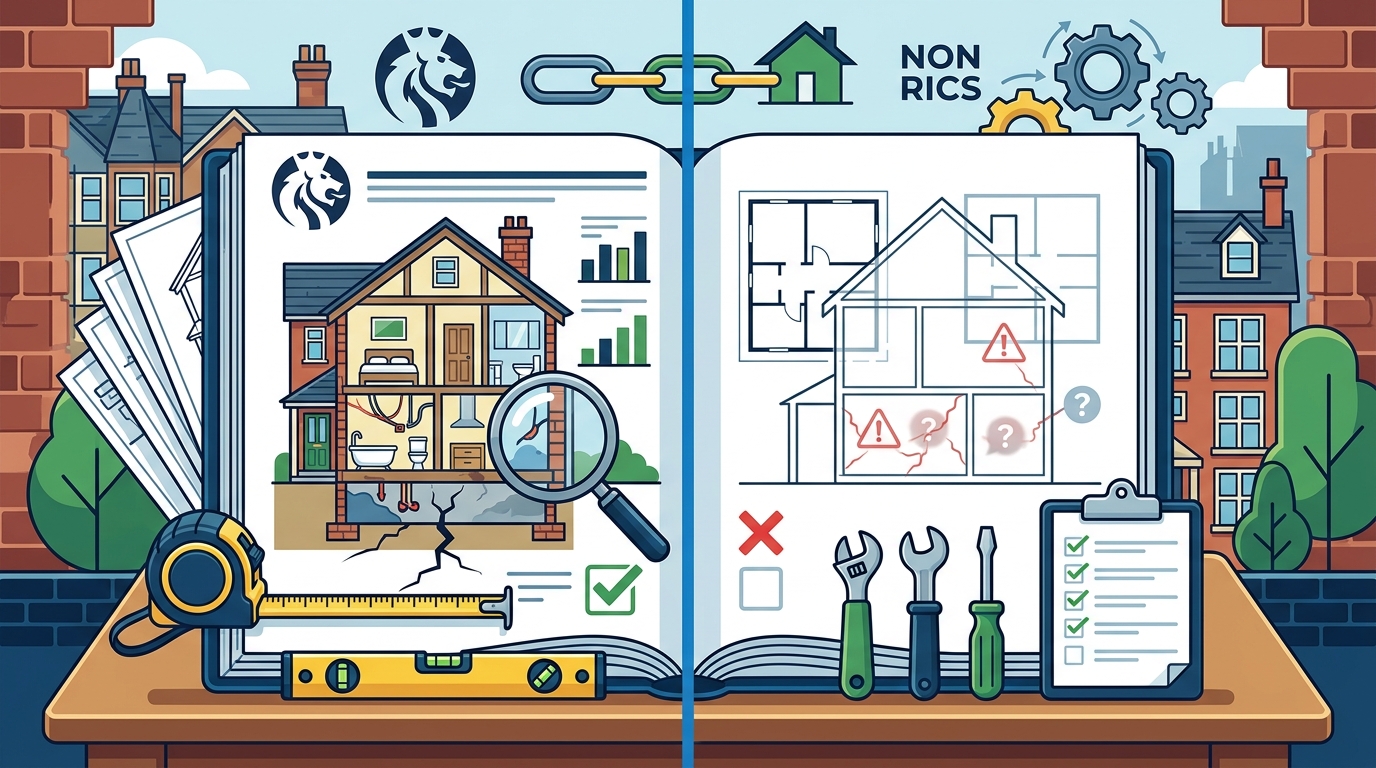
Non-regulated surveyors may offer similar reports but without the standardized format or regulatory oversight. These services often come at a lower price point but lack the uniformity that allows for easy comparison across different providers. The terminology used may vary, leading to confusion about what is actually being inspected.
Cost vs. Value Analysis
One of the primary drivers for choosing a non-regulated surveyor is cost. However, the initial savings can be misleading when compared to the long-term value of a RICS-regulated service. The cost of a survey varies based on property value, location, and size. For a typical mid-range property in the UK, a RICS Level 2 survey might cost between £400 and £900, while a Level 3 survey can range from £600 to £1,500 or more.
Non-regulated surveyors may offer prices 20-30% lower than their RICS counterparts. However, this discount often reflects a lack of professional indemnity insurance coverage. In the event of a missed defect that leads to significant repair costs, the financial liability of a non-regulated surveyor may be limited or non-existent. RICS-regulated firms carry substantial professional indemnity insurance, ensuring that clients are compensated if negligence is proven.
Consider the following comparison of service attributes:
| Feature | RICS-Regulated Surveyor | Non-Regulated Surveyor |
|---|---|---|
| Regulatory Oversight | Yes (RICS) | No |
| Professional Indemnity Insurance | Mandatory and High Value | Variable or None |
| Standardized Reporting | Yes (RICS Format) | No (Proprietary Format) |
| Dispute Resolution | Formal RICS Procedure | Private Legal Action Only |
| Lender Acceptance | Widely Accepted | Often Rejected |
When to Choose Which Service
Deciding between RICS and non-RICS services depends on several factors, including the property type, your budget, and your risk tolerance. For most residential transactions, especially those involving mortgage financing, a RICS-regulated survey is the safer and more prudent choice.
If you are purchasing a brand-new build, a RICS New Home Survey is recommended. This specialized report checks for defects in new constructions and aligns with the NHBC warranty requirements. For older properties, particularly those built before 1900, a full RICS Building Survey is non-negotiable for serious buyers. These properties often have hidden structural issues that require expert interpretation.
Non-regulated surveys might be considered for low-value commercial properties or for preliminary assessments where a full structural report is not yet required. However, even in these cases, the lack of regulatory protection poses a significant risk. It is always advisable to consult with a professional firm like A1 Surveyors to determine the appropriate level of survey for your specific situation.
Key Takeaways
- RICS Regulation Ensures Accountability: RICS-regulated surveyors are bound by strict ethical codes and professional standards, providing a safety net for clients.
- Mortgage Lender Requirements: Most UK banks and building societies require RICS-regulated surveys for loan approvals, making non-regulated options impractical for many buyers.
- Standardized Reporting: RICS reports use a consistent format, allowing for easier comparison and understanding of property conditions across different regions.
- Professional Indemnity Insurance: RICS members carry mandatory insurance that protects clients from financial loss due to professional negligence.
- Dispute Resolution: Clients of RICS surveyors have access to a formal complaints procedure, whereas non-regulated clients must rely on private legal action.
- Cost vs. Risk: While non-regulated surveys may be cheaper upfront, the potential financial risk of missed defects often outweighs the initial savings.
- Property Type Matters: Older, non-standard, or significantly altered properties require the depth of analysis provided by a RICS Building Survey.
Frequently Asked Questions
What is the difference between a RICS HomeBuyer Report and a Building Survey?
A RICS HomeBuyer Report (Level 2) is a visual inspection suitable for standard properties in reasonable condition. A Building Survey (Level 3) is a comprehensive structural analysis for larger, older, or non-standard properties, offering a much deeper level of detail and advice on repairs.
Can I use a non-regulated surveyor for my mortgage?
It is highly unlikely. Most UK mortgage lenders require a survey from a RICS-regulated firm to assess the property's value and condition. Using a non-regulated surveyor may result in your mortgage application being declined.
How much does a RICS survey cost?
The cost varies based on property value and location. Generally, a Level 2 survey costs between £400 and £900, while a Level 3 survey ranges from £600 to £1,500 or more. For a precise quote, you can contact A1 Surveyors directly.
What happens if a RICS surveyor misses a defect?
If a RICS-regulated surveyor is negligent, you may be able to make a claim against their professional indemnity insurance. RICS also has a formal complaints procedure to resolve disputes between clients and members.
Is a RICS survey necessary for a new build?
Yes, a RICS New Home Survey is recommended for new builds. It checks for defects in the construction and ensures the property meets the standards required by the NHBC warranty.
Why are RICS surveys more expensive?
RICS surveys are more expensive because they include rigorous training requirements, professional indemnity insurance, standardized reporting, and regulatory oversight. These factors ensure a higher quality of service and consumer protection.
Can I negotiate the price of a survey?
Some surveyors may offer discounts for multiple properties or off-peak times. However, be wary of prices that seem too good to be true, as they may indicate a lack of thoroughness or regulatory compliance.
Secure Your Property Investment Today
Choosing the right surveyor is one of the most important decisions you will make during a property transaction. By opting for a RICS-regulated service, you ensure that your investment is protected by the highest professional standards. Do not risk your financial future on unregulated providers. Contact A1 Surveyors today to schedule your professional property survey and gain peace of mind.